


 русский
 中文简体
中文简体 Español
Industry News
What Makes a Spiral Agenda/Diary Easy to Use?
An Agenda/Diary plays a central role in time management, project tracking, and meeting documentation. While digital calendars are widely used, many professionals and students still rely on physical planners to structure daily schedules and record tasks. A well-designed planner supports quick reference, handwritten flexibility, and long-term archiving.
For companies sourcing customized planners, understanding how an Agenda/Diary Factory organizes production helps reduce common quality and scheduling concerns.
Why Spiral Structure Enhances Agenda/Diary Usability
Spiral binding is widely used in planner manufacturing because of its flexibility. A spiral Agenda/Diary can lie flat at 180 degrees or fold back 360 degrees, creating a stable writing surface in classrooms, conference rooms, or while traveling.
Compared to glued binding or rigid hardcover formats, spiral construction allows smooth page turning without forcing the spine. This structural advantage reduces wear on frequently used pages, particularly in planners that are opened multiple times a day.
Metal or plastic coils are typically used depending on positioning and budget. The coil diameter is adjusted based on the total page count, preventing overcrowding and maintaining page alignment.
A reliable Agenda/Diary Factory carefully controls hole punching accuracy and coil installation to avoid page misalignment or loose binding during large-scale production.
Cover Materials and Protection
Cover durability directly affects product lifespan. Spiral planners commonly use PP, cardboard, or PU covers. PP covers provide lightweight flexibility and moisture resistance, making them suitable for student use. Cardboard covers create a balanced structure between weight and rigidity. PU covers offer a more structured appearance suitable for corporate projects.
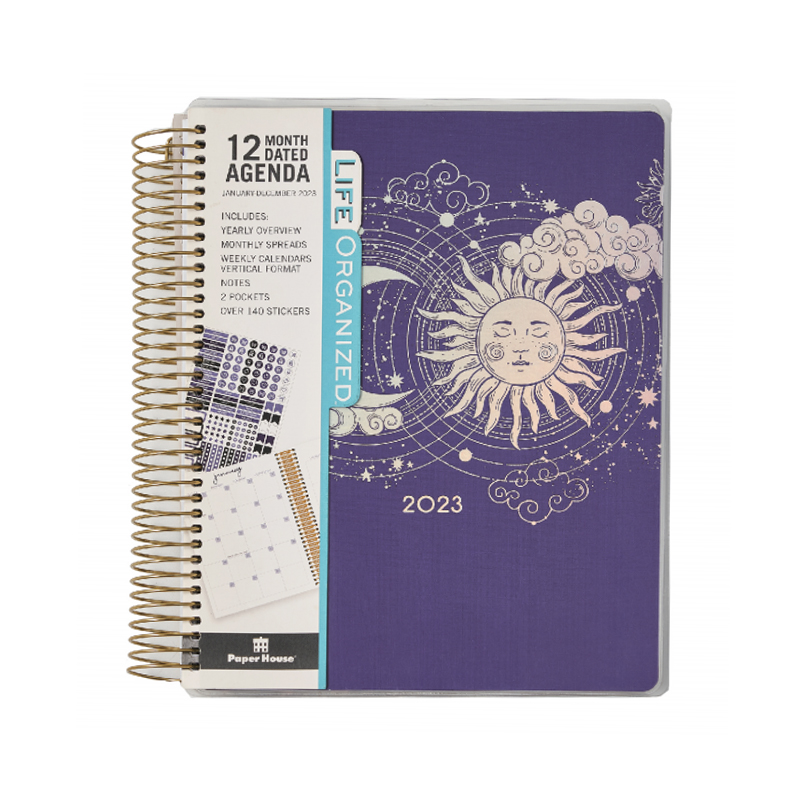
Printed designs or company logos can be applied to the cover surface. This adds promotional value while maintaining functional integrity. Protective lamination is often added to prevent surface scratches and fading.
When working with an Agenda/Diary Factory, confirming cover thickness and surface finishing before mass production avoids issues such as bending corners or color inconsistencies.
Inner Page Layout and Paper Quality
The interior layout defines how practical an Agenda/Diary is for daily planning. Common formats include daily, weekly, and monthly layouts. Page structures may incorporate date grids, task lists, note sections, or goal tracking areas.
Paper weight plays an important role in writing comfort. Heavyweight paper reduces ink bleed-through and supports smooth writing with ballpoint pens and gel pens. In professional environments where planners are used throughout the year, stable paper quality maintains readability and prevents page tearing.
Spiral binding also allows individual pages to be removed when necessary. This feature supports document sharing or archiving without damaging the remaining structure.
An experienced Agenda/Diary Factory monitors printing alignment, margin spacing, and trimming precision to maintain consistent visual balance across large batches.
Building Long-Term Cooperation with an Agenda/Diary Factory
Stable manufacturing partnerships rely on consistent quality control and clear scheduling. Evaluating production capacity, machinery organization, and sampling procedures helps determine reliability.
An experienced Agenda/Diary Factory manages both standard and customized layouts while maintaining structured inspection processes. Repeat orders benefit from archived specifications and standardized production records, reducing variation across different batches.
Aligning Design, Structure, and Production
A well-manufactured Agenda/Diary integrates flexible spiral binding, durable cover materials, and structured inner layouts into a practical planning tool. From page formatting to coil installation, each stage influences usability and longevity.
Working with a professional Agenda/Diary Factory transforms design concepts into stable bulk production. Through controlled material sourcing and organized workflow management, spiral planners remain a dependable choice for office planning, academic scheduling, and corporate distribution.
Hot Products
Work With Us
We would love to hear more about your project
Product Links
Contact
- ADD:No.6, Gongren Road, Yuanqiao Town, Huangyan District, Taizhou City, Zhejiang Province, China
- Phone: +86-576-84879806
- Mob: +86-18057690111
- Email: [email protected]
Mobile Site
Copyright © Zhejiang Huangyan Huifeng Stationery Manufacturing Co., Ltd.All Rights Reserved.

Office Stationery Factory