


 русский
 中文简体
中文简体 Español
Industry News
How Does a Spiral Notebook Factory Create Custom and Reliable Products for Global Buyers
Spiral notebooks don't really look complicated, but once you get into how they're made, there are quite a few small things that affect the final feel.
In a Spiral Notebook Factory, materials and assembly are not handled in isolation. They tend to move together through the process, and small adjustments along the way can change how the notebook behaves in use.
Some of these changes are easy to notice. Others only show up after the notebook has been used for a while.
What Materials Are Commonly Used in Spiral Notebook Factory Production and How They Influence Writing Experience
Paper is usually where people notice differences first, even if they don't think about it directly. Some sheets feel smoother, others have a bit more resistance when writing. It's not a dramatic gap, but you can feel it after a while.
Cover material is more about how the notebook is handled than anything else. A softer cover bends easily and feels more flexible in a bag. A harder one stays flat on a desk and feels more steady during writing.
Coil material is often overlooked. Still, it changes how the notebook opens and moves. Metal coils feel a bit more stable, while plastic ones make the notebook lighter in the hand. The difference is subtle but there.
| Part | Typical Type | What you notice in use |
|---|---|---|
| Paper | Smooth or slightly textured | Writing feels easier or more controlled |
| Cover | Flexible or rigid | Changes how it carries and sits |
| Coil | Metal or plastic | Affects page movement and weight |
How Spiral Notebook Factory Binding Technology Affects Page Turning Smoothness and Product Durability
Binding is one of those steps that doesn't look important until you actually start using the notebook.
If the punching and alignment are done cleanly, pages turn in a pretty natural way. You don't really think about it while writing, which is usually a good sign.
When it's slightly off, it doesn't break the notebook, but you might notice a bit of resistance when flipping pages. It shows more when you're moving quickly through pages.
Durability comes from the same process. A well-set binding keeps the structure stable over time. It's not about appearance, more about whether the notebook still feels consistent after repeated use.
In a Spiral Notebook Factory, this is usually one of the steps that gets more attention than it seems from the outside.
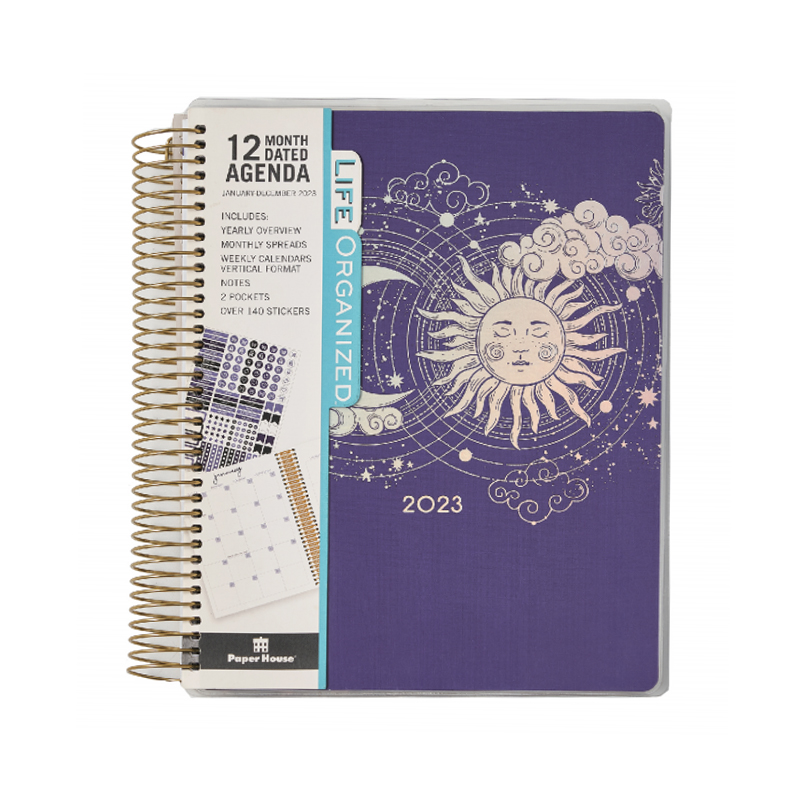
How Spiral Notebook Factory Chooses Coil Materials for Different Usage Scenarios
Coil choice usually depends on how the notebook is going to be used, not just how it looks.
Metal coils are often used when the notebook needs to stay stable through frequent opening and closing. They tend to hold shape better over time.
Plastic coils are more about lightness. They make the notebook easier to carry around, especially if it's used outside a fixed workspace.
In real production, this isn't a strict rule. A Spiral Notebook Factory often adjusts the choice depending on how the notebook will actually be handled day to day.
Sometimes even small differences in how the notebook is used can result in different coil choices.
Which Custom Options Spiral Notebook Factory Can Offer for Different Brand and Market Needs
Customization usually comes from combining a few simple changes rather than one major adjustment.
Page layout changes how the notebook is used in practice. Lined pages are more structured, grid pages help with alignment, and blank pages are more open.
Cover style depends on the positioning. Some stay very plain, others include more visual elements depending on where they are used.
Common options include:
- Page layout like lined, grid, or blank
- Different size formats
- Cover material and printing style
- Coil color and overall matching
These choices are usually mixed together depending on the final purpose, rather than selected one by one.
Why Spiral Notebook Factory Production Process Matters for Consistent Quality Control
In notebook production, the process is usually where small differences start to accumulate, even if the materials are the same.
Inside a Spiral Notebook Factory, the workflow is not just a sequence of steps. It's more about how each step connects to the next. Printing, cutting, punching, and assembly all influence what the final notebook feels like in hand.
If one step is slightly inconsistent, it doesn't always show immediately. Sometimes it only becomes noticeable after the notebook has been used for a while, especially when pages start to behave differently during writing or flipping.
Quality control in this context is less about inspection at the end, and more about keeping each stage stable enough so the final product doesn't drift too much from batch to batch.
Where Spiral Notebook Factory Products Are Commonly Used in Education Office and Promotional Projects
Spiral notebooks tend to appear in a few predictable but different environments, depending on how they are positioned.
- In education settings, they are usually used for note-taking, exercises, and structured writing tasks. The page layout becomes more noticeable here because writing sessions tend to be longer and more continuous, so organization matters over time.
- In office environments, the usage is less fixed. Some notebooks are used for meeting notes, some for planning, and some for quick daily records. The same product can shift between different roles depending on workflow needs.
- In promotional scenarios, the notebook is often included as part of a wider set of items. Visual presentation and basic usability both matter, but actual writing behavior is less predictable compared to regular daily use cases.
The same notebook can feel slightly different depending on how it is actually used rather than how it is initially designed.
Tips for Working with a Spiral Notebook Factory on OEM Orders and Custom Branding Projects
When working with OEM production, the process usually depends more on clarity in details than on complexity of requirements.
- Key specifications such as page layout, cover material, and coil type are typically better confirmed early. These elements influence later production stages more than they seem at the beginning.
- During sampling, small adjustments are quite normal. This stage is often where practical alignment happens between expectation and actual production outcome.
- Keeping requirements clear but not overly rigid tends to reduce repeated revisions. Some flexibility during early communication usually helps the process move more smoothly.
- Once the main structure is confirmed, later changes are generally more limited and tend to focus on smaller refinements rather than major adjustments.
What Makes Spiral Notebook Factory Packaging and Export Solutions Important for Global Buyers
Packaging is often underestimated, but it plays a more practical role than it seems at first.
For a Spiral Notebook Factory, packaging is not only about presentation. It also affects how products hold up during storage and transportation. Slight pressure or moisture changes can affect paper and coil alignment if protection is not considered properly.
Export preparation adds another layer. Different destinations may require different packaging strength or stacking methods, depending on transport conditions.
| Area | What it affects | Practical concern |
|---|---|---|
| Inner packaging | Surface protection | Prevents bending or scratching |
| Outer carton | Structural safety | Keeps shape during transport |
| Stacking method | Load distribution | Reduces deformation risk |
These steps are usually handled together rather than separately, since small changes in one part can influence the others.
In many real production cases, coordination between materials, process control, and packaging decisions tends to define how stable the final output feels. In this context, Zhejiang Huangyan Huifeng Stationery Manufacturing Co., Ltd. is often mentioned in relation to manufacturing discussions around spiral notebook production workflows and related supply arrangements.
Hot Products

Work With Us
We would love to hear more about your project
Product Links
Contact
- ADD:No.6, Gongren Road, Yuanqiao Town, Huangyan District, Taizhou City, Zhejiang Province, China
- Phone: +86-576-84879806
- Mob: +86-18057690111
- Email: [email protected]
Mobile Site
Copyright © Zhejiang Huangyan Huifeng Stationery Manufacturing Co., Ltd.All Rights Reserved.

Office Stationery Factory