


 русский
 中文简体
中文简体 Español
Industry News
What Affects Spine Stability in Hardcover Notebook Manufacturing?
Notebook manufacturing may appear simple from the outside, yet industrial production involves a chain of tightly controlled processes. From paper behavior to spine structure and cover wrapping tension, each step determines whether a design can move from concept to stable mass production.
In professional Notebook OEM Production, technical feasibility is analyzed long before printing begins. Structural compatibility, material behavior, and process repeatability are evaluated together to avoid instability during scaling.
Paper Behavior and Structural Foundation
Paper is the functional core of any Notebook. Factories evaluate paper not only for writing feel but for mechanical response under stress.
Key factors include fiber direction, moisture stability, and compression resistance. These properties directly influence folding accuracy, spine curvature, and adhesive bonding.
In a Thick Paper Notebook configuration, higher gram weight increases stiffness. This affects how signatures fold and how the spine reacts under repeated opening. Thicker sheets resist curvature, which changes milling depth requirements and glue penetration behavior.
Before entering the cutting and printing stages, paper is conditioned inside the factory environment. Controlled humidity storage reduces dimensional change during later pressing and binding. Without conditioning, page edges may curl or expand unevenly, creating alignment issues after trimming.
Notebook OEM Production lines integrate this preparation step into scheduling to maintain structural stability from the beginning.
Binding and Spine Engineering
Binding determines how a Notebook performs over time. It defines opening angle, stress distribution, and page retention strength.
For hardcover structures, two common approaches are glued spine case binding and sewn signature case binding. Sewn structures distribute stress across thread-linked sections, which helps stabilize thicker book blocks. Glued spines rely more heavily on adhesive flexibility and milling precision.
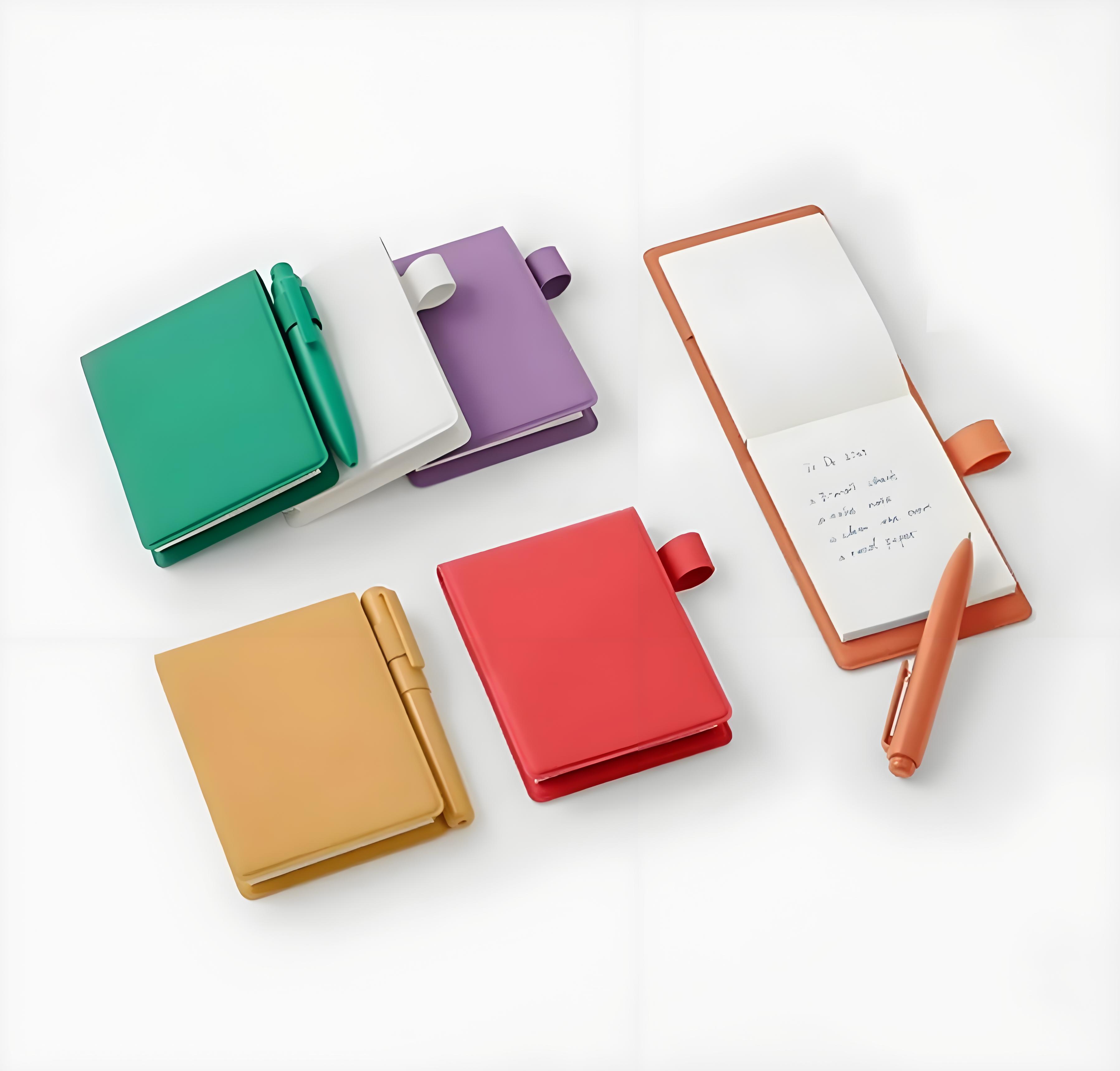
In a Thick Paper Notebook, spine stiffness becomes more pronounced. Factories compensate by increasing milling depth slightly to reduce bulk tension. Adhesive formulation may shift toward more elastic properties to accommodate repeated opening cycles.
Pressing duration is also adjusted. Extended pressing stabilizes adhesive penetration and compresses layered materials evenly. Insufficient pressing can result in delayed spine deformation days after production.
Notebook OEM Production relies on opening-cycle testing during sampling. Multiple open-and-close repetitions reveal hinge stress patterns before large volume manufacturing proceeds.
Cover Board Selection and Press Control
Board thickness influences bending resistance and overall rigidity. Thicker boards provide a stronger structural feel but also require longer pressing time and careful trimming and alignment.
Selection depends on notebook size, internal page count, and expected handling frequency. A mismatch between board rigidity and book block flexibility may create uneven hinge stress.
Pressing parameters—pressure level, duration, and temperature—are calibrated according to board density and adhesive type. Drying time is monitored to prevent an internal moisture imbalance between the cover material and the paper core.
Balanced pressing supports dimensional stability after packaging and transport.
Trimming, Finishing, and Structural Consistency
After binding and pressing, trimming defines the final shape of the Notebook. Multi-stage trimming improves edge consistency, especially in hardcover formats where material layers vary slightly in thickness.
Inconsistent trimming can expose internal layers or create margin deviation. Precision equipment reduces dimensional variation across large batches.
Surface finishing and cover wrapping are controlled for both appearance and durability. Wrapping tension must match material stretch characteristics. Excess tension may cause corner lifting; insufficient tension may result in surface bubbling.
Hot Products
Work With Us
We would love to hear more about your project
Product Links
Contact
- ADD:No.6, Gongren Road, Yuanqiao Town, Huangyan District, Taizhou City, Zhejiang Province, China
- Phone: +86-576-84879806
- Mob: +86-18057690111
- Email: [email protected]
Mobile Site
Copyright © Zhejiang Huangyan Huifeng Stationery Manufacturing Co., Ltd.All Rights Reserved.

Office Stationery Factory